
Why Mould Appears in Winter (and How to Stop It)

Why mould shows up as soon as the heating goes on
Every autumn in Berlin, the same thing happens. The heating goes on, the windows stay shut, and a few weeks later black spots appear on the window frame, behind the wardrobe or in the corner of the bathroom ceiling.
It's not bad luck. Mould in winter has a simple cause: warm, humid indoor air meets a cold surface and turns into water. Wherever that water sits for days, mould grows.
The good news: most winter mould is preventable with a few daily habits. And if it has already appeared, small patches can be treated quickly before they spread, or before your landlord sees them at handover.
In this guide, we explain why it happens in Berlin flats specifically, how to stop it, and when it's time to call a professional.
What causes mould in winter?
A normal household releases several litres of moisture into the air every day through cooking, showering, drying laundry and simply breathing. In summer, open windows carry it away. In winter, it stays inside and looks for the coldest surface to settle on.
1. Condensation on cold surfaces
Warm air holds more moisture than cold air. When it touches a cold window pane, an outside wall or a corner, it cools down and releases water. That thin film of moisture is all mould needs.
2. Altbau and Kastenfenster windows
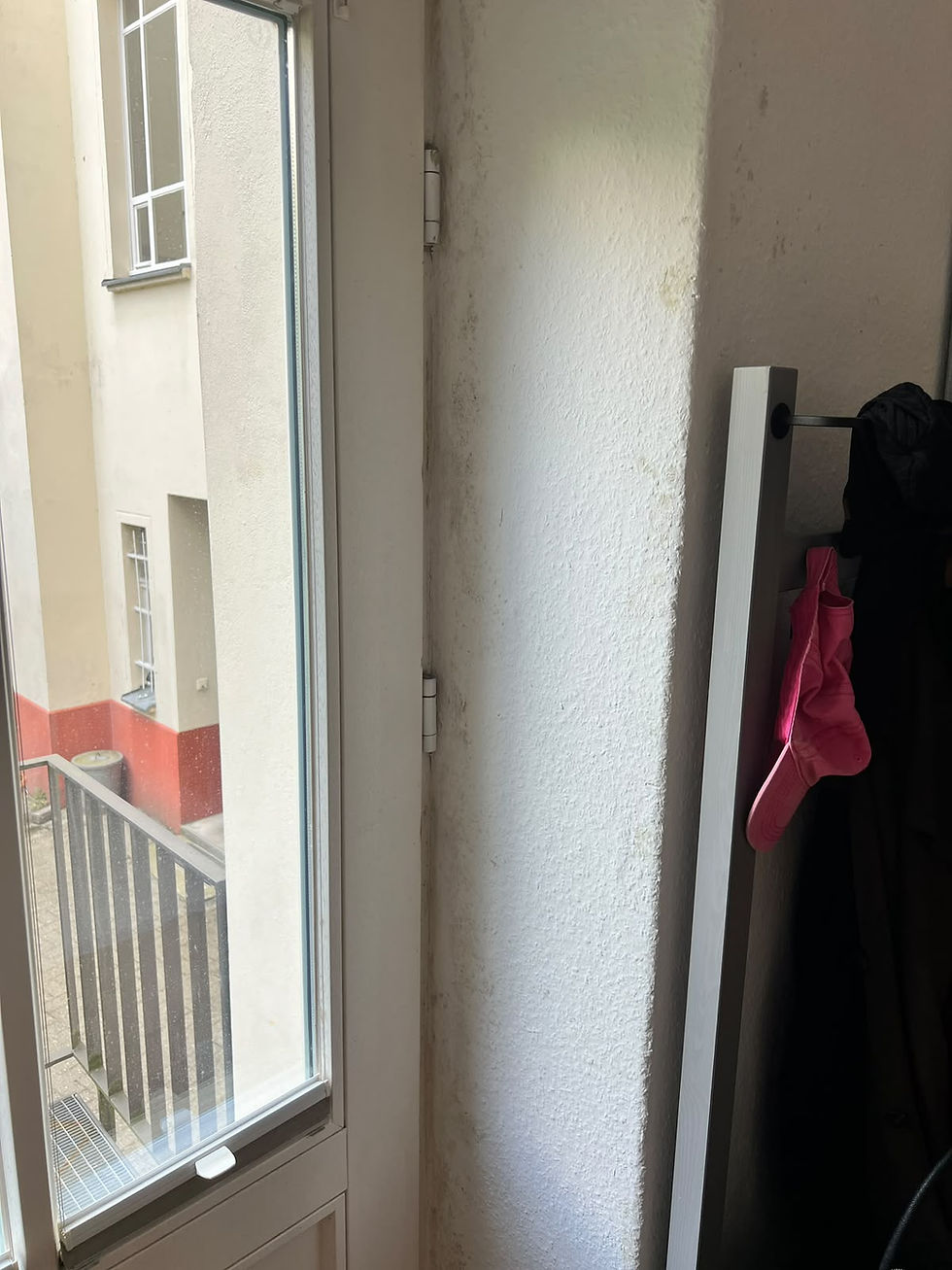
Berlin's beautiful old buildings come with old windows. Box windows (Kastenfenster) and single-glazed frames get very cold, so condensation collects on the glass, runs down and soaks into the wooden frame and the sill. Black spots in the frame corners are one of the most common problems we see in Altbau flats in Prenzlauer Berg, Friedrichshain, Kreuzberg and Schöneberg.
3. Cold outside walls and corners
Corners where two outside walls meet are the coldest spots in a room. Ceilings above unheated attics or stairwells are similar. Mould often starts here first.
4. Furniture pushed against outside walls
A wardrobe, bed or sofa placed flat against an outside wall blocks warm air from reaching it. The wall behind stays cold and damp, and mould grows unseen until you move the furniture, often only at move-out.
5. Bathrooms without windows
Many Berlin bathrooms have only an extractor fan, or nothing at all. After a hot shower, the humidity has nowhere to go. Silicone joints, grout and the ceiling above the shower are the first to turn black.
6. Drying laundry indoors
One load of wet laundry can release up to two litres of water into the air. In a small flat with closed windows, that alone can push humidity into the danger zone.
How to prevent mould in your flat this winter
Air the German way: Stoßlüften
Open the windows wide for 5–10 minutes, 2–3 times a day, ideally with windows on opposite sides open at the same time (Querlüften). This swaps humid indoor air for dry outdoor air quickly, without cooling the walls down.
What doesn't work: leaving a window tilted (gekippt) all day. It barely exchanges the air but chills the wall around the window, which makes condensation worse.
Keep every room heated
Don't let rooms go fully cold, even ones you rarely use. Around 19–21 °C in living areas and at least 16–17 °C in bedrooms is a good rule. Cold rooms are where condensation collects.
Watch your humidity
A simple hygrometer costs about €10. Aim for 40–60% humidity indoors. If it regularly reads above 60%, air more often.
Daily habits that make a big difference
Air the bathroom and kitchen straight after showering or cooking, door closed to the rest of the flat
Wipe condensation off windows and sills every morning, especially on Kastenfenster
Squeegee shower walls and leave the bathroom door open afterwards
Keep furniture 5–10 cm away from outside walls
Dry laundry outside, in a drying room, or with the window open in that room
Use lids on pots when cooking
Can you remove mould yourself, or do you need a professional?
Small, surface spots you can often handle yourself. A few black dots on a window frame, silicone joint or tile grout can be wiped with 70% alcohol (Isopropanol or Brennspiritus) on a cloth. Wear gloves and a mask, air the room well, and throw the cloth away afterwards.
Avoid dry brushing or vacuuming mould: it spreads the spores. Bleach-based sprays may whiten the stain without killing the mould in porous surfaces like plaster or wood.
Call a professional when:
The patch is larger than roughly a sheet of A4 paper, or spread over several spots
It keeps coming back in the same place after cleaning
It's on plaster, wallpaper or behind furniture, not just on tiles or glass
You're moving out and need the flat handover-ready
Someone in the household is sensitive to mould, such as children or people with respiratory problems
As a rough guide, Germany's Federal Environment Agency (Umweltbundesamt) recommends leaving larger affected areas to specialists rather than DIY.
Renting in Berlin? What mould means for your deposit
For tenants, mould is not just a health and comfort issue. It's one of the most common reasons for deposit deductions at handover (Wohnungsübergabe).
Report it early. Tenants in Germany are generally expected to inform the landlord or Hausverwaltung about defects like mould promptly. Do it in writing, with photos and the date.
Cause matters. If mould comes from a building defect (leaks, poor insulation, damaged pipes), it's usually the landlord's responsibility. If it comes from insufficient airing or heating, the tenant may be held responsible.
Document everything. Take dated photos when you spot it, after treatment, and at move-out.
Treat it before handover. Visible black spots on frames, joints or ceilings are an easy reason for a landlord to keep part of your deposit.
This is general information, not legal advice. For disputes, contact a tenants' association such as the Be


rliner Mieterverein.
How BerlinCleaner treats mould
We treat surface mould in bathrooms, kitchens, window frames, ceilings and wall corners across Berlin, including Altbau flats with Kastenfenster.
Send us photos on WhatsApp. We assess the size and give you a fixed price.
Deep clean of the affected areas. We remove the black spots and clean the surrounding surfaces.
Anti-mould paint. Treated wall and ceiling areas get a coat of anti-mould paint to help stop it coming back.
Photo documentation. You get before-and-after photos, useful for your landlord or handover.
Package | Price |
Small areas (e.g. bathroom ceiling corner, window frames) | from €149 |
Medium areas or several spots | from €199 |
Larger areas | fixed quote from photos or a short visit |
Mould treatment can also be added to a move-out, move-in or deep cleaning, so everything is done in one visit. Our English-speaking team is fully insured (€5M liability).
Send us a photo on WhatsApp for a quick quote, or see our Mould Removal Berlin page.
FAQ
Why does mould appear on my windows every winter?
Warm, humid indoor air condenses on the cold glass and frame. The water collects in the corners and on the sill, and mould grows there within days. Wiping condensation every morning and airing 2–3 times a day prevents most of it.
Is a tilted window enough to stop mould?
No. A tilted window barely exchanges the air but cools the wall around it, which can make mould worse. Open windows fully for 5–10 minutes instead.
How much does mould removal cost in Berlin?
At BerlinCleaner, mould treatment starts at €149 for small areas, including cleaning and anti-mould paint. Larger areas are quoted at a fixed price from photos.
Will mould affect my deposit when I move out?
It can. Visible mould is a common reason for deposit deductions. Treat it before handover and keep dated photos of the treated areas.

Comments